
Should You Add a Theater Room to Your Basement?
Pros & Cons
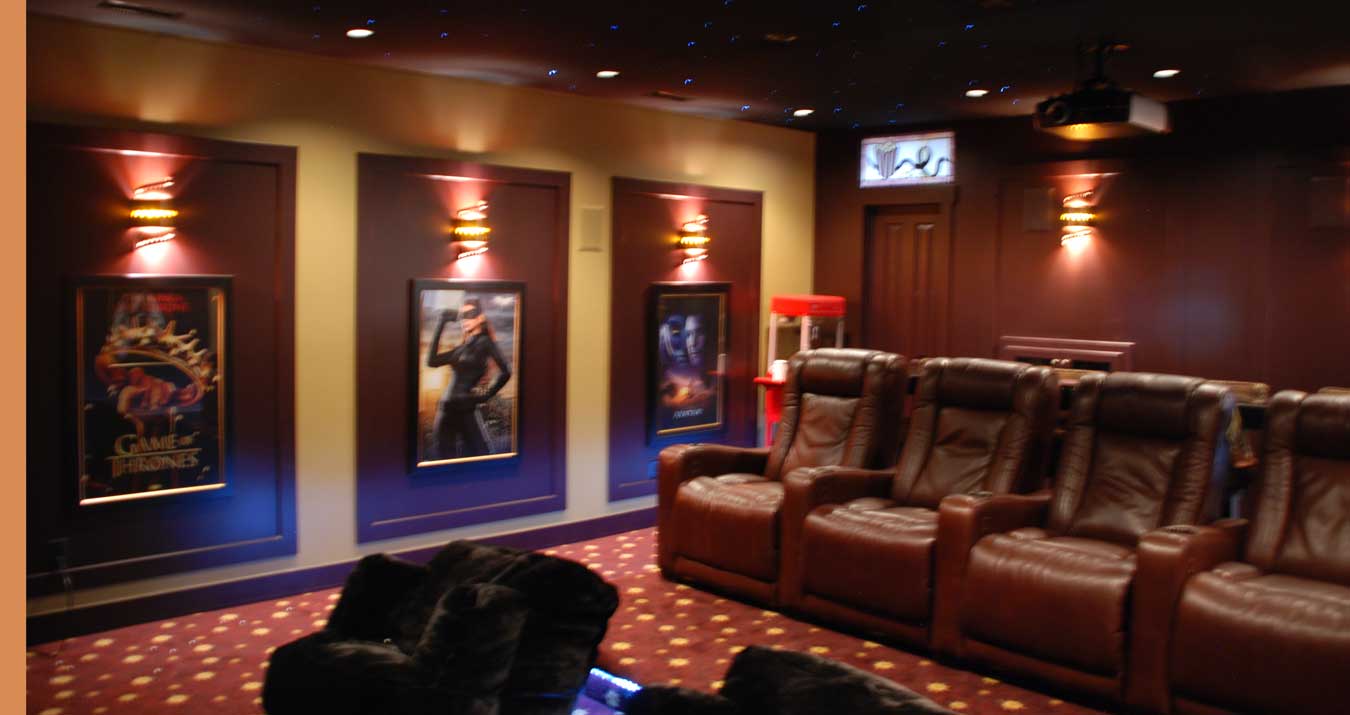
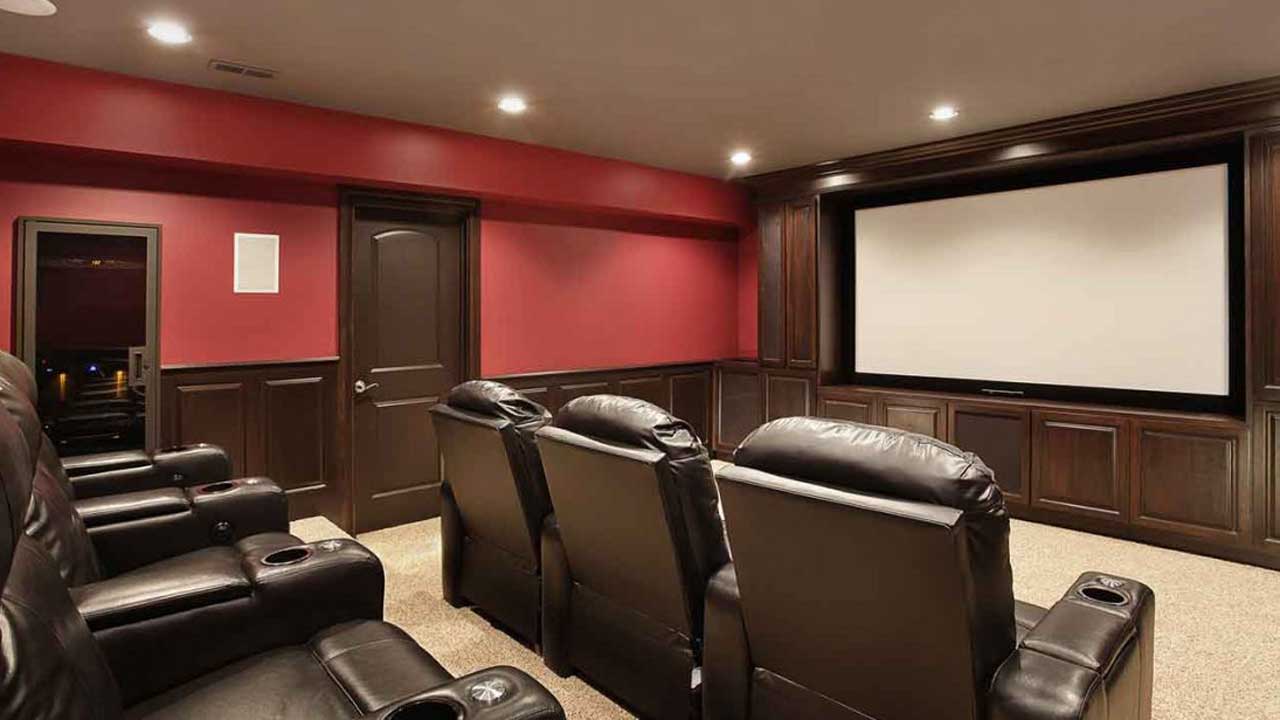
Theater rooms are great additions to any basement finish. If they get used to it, they can be the highlight or the basement. Unfortunately, sometimes theater rooms get little use and end up as an expensive addition that could have been put to better use.
Basement Theater Rooms: Are They Worth It?
A basement seems like the perfect place for a home theater.
It’s naturally darker. There usually aren’t many windows to work around. We can add insulation to the walls and ceiling to help with sound, and you can turn up a movie without worrying quite as much about disturbing the rest of the house.
And with today’s enormous TVs and surprisingly good sound systems, you can create a pretty impressive setup without building anything close to an actual movie theater.
But here’s the question we think homeowners should ask before they build one:
Do you really want a dedicated theater room?
We’ve built them, and they can be fantastic. We’ve also seen homeowners spend quite a bit of money and basement space on a theater room that doesn’t get used nearly as often as they expected.
Sometimes a big TV, comfortable sectional, and good sound system in the family room is the better choice.
Let’s look at both options.
Why Basements Work So Well for Theater Rooms
There are some real advantages to putting a theater downstairs.
The biggest is light.
Basements naturally have fewer windows than the main floor, which makes it much easier to control glare on the screen. If you’re using a projector, that’s especially helpful.
You also have fewer windows and doors dictating where everything has to go.
That gives us more freedom when deciding where to put the screen, speakers, and seating.
Then there’s sound.
We can add sound-dampening insulation while we’re finishing the basement, which can help reduce how much noise travels upstairs.
It won’t make the room completely soundproof. A powerful subwoofer is still a powerful subwoofer, and low-frequency sound has a way of traveling through a house.
But planning for sound before the drywall goes up can certainly help.
TVs Have Changed Home Theaters
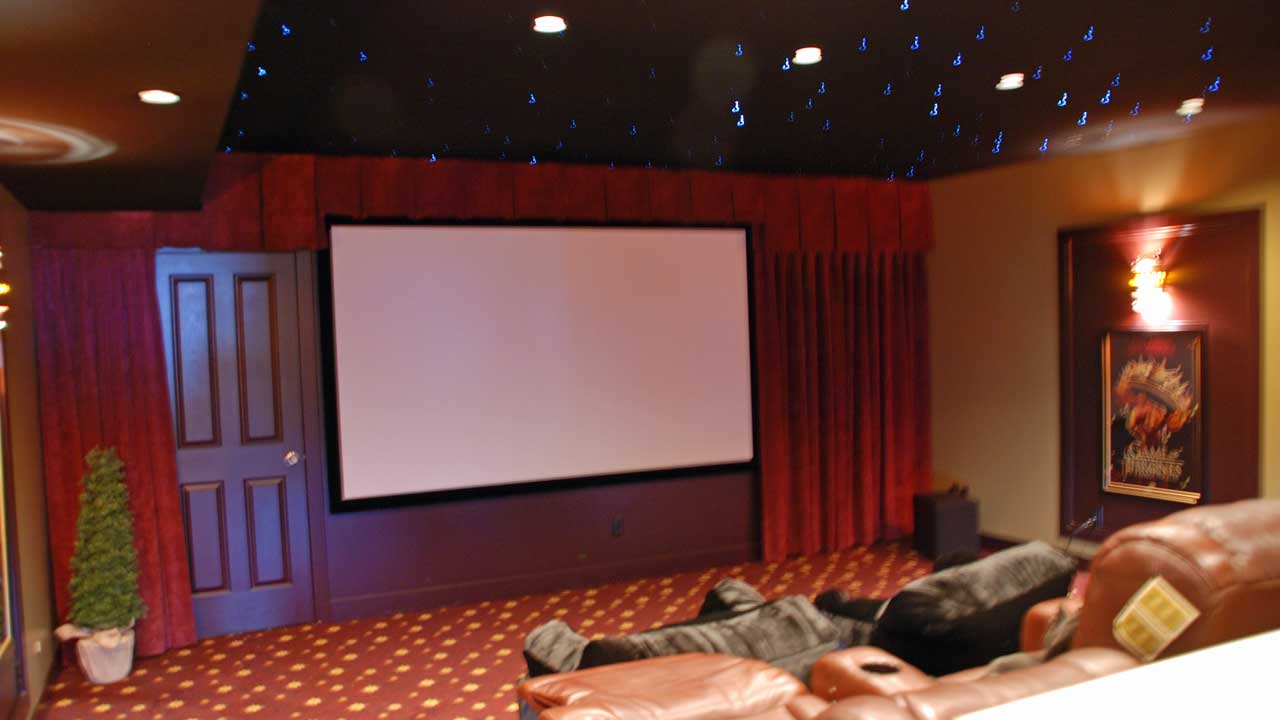
Ten or fifteen years ago, if someone wanted a really big home theater screen, a projector was usually the obvious answer.
That’s not necessarily true anymore.
Large TVs have gotten much bigger and better.
They’re bright, incredibly sharp, easy to use, and you don’t have to worry as much about controlling every bit of light in the room.
Projectors still make sense if you want a truly enormous image or you’re going for the traditional theater experience.
But for many of the basements we finish today, a large TV is the simpler option.
Turn it on and it works.
There’s something to be said for that.
Sound Doesn’t Have to Be Complicated Either
The same thing has happened with audio.
You can still install speakers throughout the room, hide wiring in the walls, and build a serious surround-sound system.
If you’re really into movies and audio, that’s probably worth doing.
But you don’t have to.
Modern soundbars, wireless speakers, and Bluetooth systems have made it much easier to get good sound without turning the room into an electronics project.
This is one area where we’d decide what you want before we finish the walls.
Even if you’re not buying all of the equipment immediately, we can plan outlets, wiring, speaker locations, and TV placement while everything is open.
That’s a lot easier than cutting holes in your brand-new drywall six months later.
Tiered Seating Is Fun—If You Have the Room
We’ve built theater rooms with raised seating, and there’s no question that it makes the room feel more like an actual theater.
It’s also fun.
If you’re going all-in on a dedicated movie room, stadium-style seating can be a great addition.
But it takes space.
You need enough room for the platform, seating, walkways, and screen while still keeping comfortable viewing distances.
Ceiling height matters too.
A raised second row in a basement with a lower ceiling needs to be planned carefully. You don’t want to build a beautiful platform and then realize the people sitting in the back feel like their heads are touching the ceiling.
This is another one of those things that’s much easier to figure out on the plans.
The Case Against a Dedicated Theater Room
Here’s the part we think homeowners should hear before spending the money.
You may not use it as much as you think.
We did an informal survey of 21 of our clients who had included theater rooms in their basements.
Only five told us they were using the theater regularly.
That’s not a scientific study, and we’re certainly not claiming that 76% of theater rooms go unused.
It’s simply what we heard from a small group of our own customers.
But it made us think differently about how we talk to homeowners about theater rooms.
A dedicated theater sounds amazing when you’re designing the basement.
Then real life happens.
The kids watch something on their tablets. Someone wants to watch football while somebody else is doing something in the basement. The family ends up sitting in the big comfortable family room because that’s where everyone naturally gathers.
Meanwhile, the dedicated theater is sitting empty.
That doesn’t mean you shouldn’t build one.
It means you should build one because you know you’ll use it, not because every luxury basement is supposed to have a theater.
A Media Room May Make More Sense
For a lot of families, this is what we’d recommend instead.
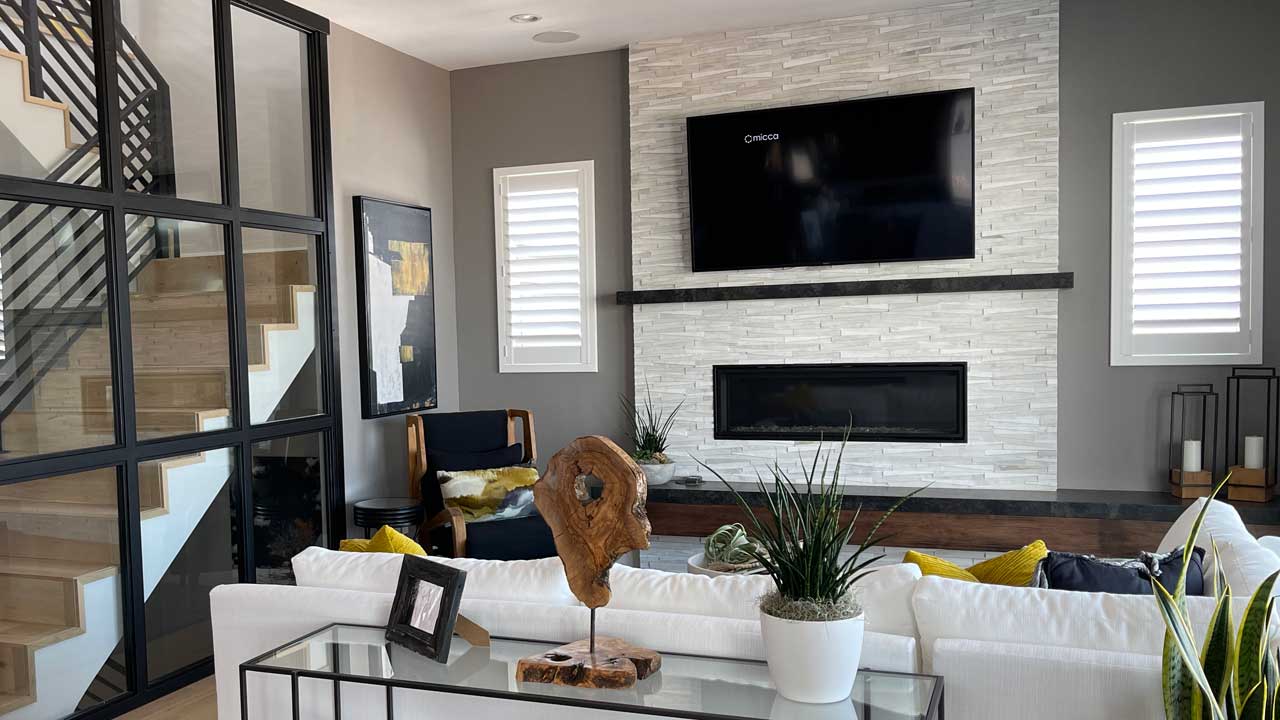
Build a great family room and give it some theater features.
Put in a large TV.
Add a good sound system.
Plan the lighting so you can dim the room for movies.
Buy a comfortable sectional made for lounging.
Add sound insulation while the ceiling is open.
Now you have a pretty great place to watch a movie.
But when you’re not watching a movie, it’s still your family room.
The kids can play video games there. You can watch football with friends. Someone can sit on the couch and read. You can add a pool table or game table nearby.
You’re getting much more use out of the square footage.
For many families, that’s a better trade.
Don’t Forget About Comfortable Seating
People spend a lot of time thinking about the television and sound system.
Don’t forget about where you’re actually going to sit.
Speaking from personal experience, some of the big sectionals designed for movie watching are fantastic.
If I’m spending two or three hours watching a movie, I’d rather put some of the budget into a really comfortable couch than into an electronic feature I can barely tell the difference between.
And there’s another advantage to watching movies at home:
Nobody you don’t know is sitting six inches away from you and taking up half your armrest.
That’s worth something.
Watch How Much You Spend
Home theaters are one of those basement features where the budget can get away from you quickly.
There’s always a better TV.
There’s always a better projector.
There’s always another speaker.
Then you start looking at theater seating, lighting controls, acoustic treatments, built-ins, wall panels, and everything else.
Pretty soon, you’ve spent a surprising amount of money on one room.
There’s nothing wrong with that if movies are your thing.
We’ve had homeowners who genuinely love their theater rooms and use them all the time. For them, spending more on the room makes sense.
But if you watch a movie once every couple of months, you probably don’t need to build a miniature Cinemark in your basement.
A big TV and a comfortable couch may make you just as happy.
Think About the Room Before You Buy the Equipment
This is probably the biggest piece of advice we’d give anyone considering a basement theater.
Figure out the room first.
Where is the screen going?
Where will you sit?
How far will the seating be from the screen?
Where do the speakers need to go?
Where will you need outlets?
Do you want dimmable lights?
Do you need wiring behind the TV?
Are you planning a projector?
Do you want sound insulation in the ceiling?
These decisions affect the construction of the room.
We’ve found it’s much easier to move an outlet or add speaker wire while the walls are open than after the basement is completely finished.
You don’t necessarily need to buy the TV before construction starts.
You just need to know what you’re planning for.
So, Is a Basement Theater Worth It?
It depends on your family.
If you’re the family that watches movies together every Friday night, hosts friends for every big game, or genuinely loves the theater experience, then absolutely consider building one.
You may use it constantly.
If you’re not sure, we’d think seriously about a media room instead.
You can still have the huge TV, great speakers, comfortable seating, dimmable lights, and movie-night atmosphere without dedicating an entire room to one purpose.
That’s actually what we see making sense for more homeowners today.
And if you’re still undecided, that’s something we can talk through during the design process.
We’ve built dedicated theaters, simple TV rooms, and just about everything in between.
The goal isn’t to convince you to build the most expensive room possible.
It’s to build the room you’re actually going to use.
Thinking about adding a theater or media room to your Utah basement? Contact Utah Basement Finisher at 385-343-7847 for a free in-home consultation and detailed quote.
continue reading
Related Posts
An 8-foot basement ceiling doesn’t have to feel low or cramped. With the right lighting, colors, flooring, layout, and a few smart design choices, you can make your basement feel taller, brighter, and more open.
Planning a basement finishing project is not just about adding square footage. The goal is to create a space that fits naturally with how you live in your home.
Planning a basement finishing project is not just about adding square footage. The goal is to create a space that fits naturally with how you live in your home.